Search engine optimization helps a website communicate its purpose to people and search engines. For a business, the goal is relevant visibility: being discoverable when someone is looking for information or a service you can genuinely provide. More visits alone are not enough if the pages attract the wrong audience or fail to answer the question behind the search.
SEO combines useful content, understandable page structure, and technical reliability. It is an ongoing practice rather than a one-time setting. No responsible plan can guarantee a particular ranking, but a methodical approach can remove avoidable obstacles and make the website more useful.
Start with search intent
Think about what the searcher needs to accomplish. Someone researching what a customer portal does needs an explanation. Someone comparing implementation options needs scope, limitations, and practical differences. Someone ready to contact a supplier needs a clear service page and a straightforward next step.
Group related questions instead of creating a separate thin page for every keyword variation. A strong page can answer several closely connected questions naturally. Use sales and support conversations to identify the vocabulary customers actually use, then review search results as context rather than copying competitors’ wording or structure.
Make important pages understandable
Each page should have a clear topic, a descriptive title, and a logical heading structure. Explain the main subject early. Break supporting information into sections that readers can scan without losing the thread of the explanation.
A service page should identify the service, the audience, what is included, and how a project begins. Meaningful examples are more helpful than paragraphs filled with repeated location or service phrases. Where a technical term is necessary, explain it. Good SEO content should still be useful when no search engine is involved.
Create content with a clear purpose
An article should solve a real information problem. It might explain a process, compare suitable approaches, or help readers prepare for a project. Avoid publishing a series of nearly identical articles simply to target slight variations in wording.
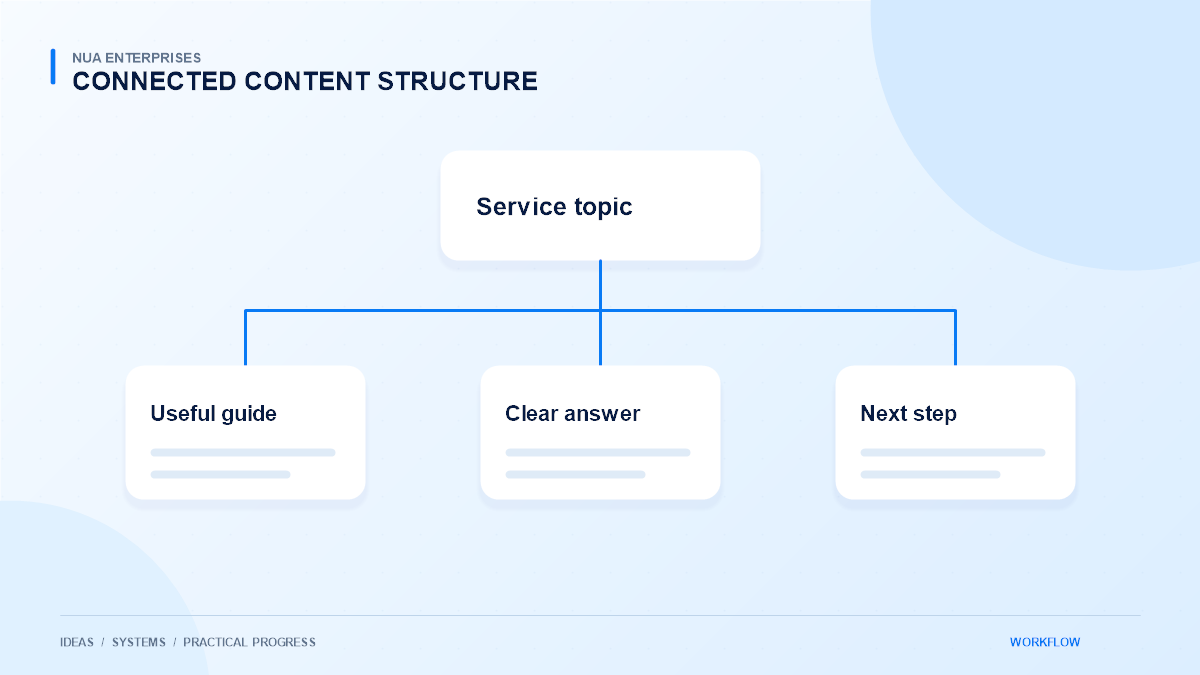
For example, a business software provider can explain how to document an approval workflow before commissioning software. The article can then link to a relevant service page. This relationship supports readers who want more help without forcing a sales pitch into every section. Keep claims realistic and review content when the underlying service changes.
Check crawlability and indexing foundations
Important public pages need working links and an appropriate response when requested. Accidental access restrictions, broken navigation, or incorrect indexing directives can prevent useful content from being discovered. Duplicate URLs can also make it harder to understand which page is the preferred version.
Keep WordPress metadata ownership clear
On WordPress, review permalink settings, sitemap output, canonical ownership, and SEO plugin configuration carefully. Avoid installing multiple tools that generate conflicting metadata. Changes to redirects, robots directives, or indexing rules should be reviewed on staging first, especially when an established site already receives search traffic.
Use internal links as helpful navigation
Internal links explain how information fits together. Link from a broad service page to relevant guides, and from guides back to the appropriate service where useful. The link text should describe the destination rather than repeating Click Here across the site.
A reader learning about website performance might need a related explanation of image optimization or maintenance. Place those links where the next question naturally appears. Do not add unrelated links solely to increase a count. A smaller number of relevant connections usually produces a clearer reading experience and a more coherent structure.
Treat images and performance responsibly
Use images that clarify the content, give informative images descriptive alternatives, and deliver files at sensible dimensions. An image should not make a mobile visitor download a needlessly large asset when a smaller version would serve the same purpose.
Performance work should consider actual pages and devices. Check that navigation, forms, and important content remain usable after optimization. Search visibility is not a reason to remove useful features blindly. A website that loads quickly but hides its main content or breaks customer interactions has not solved the underlying experience problem.
Keep local and business information accurate
If the business serves a defined area, explain its genuine service coverage and maintain consistent contact details. Do not invent offices, customer reviews, or local projects. Location-specific content should provide information that is actually relevant to people in that area.
The same principle applies to expertise claims. Explain the process, show approved work, and identify who is responsible for the content where appropriate. Trust is built through accurate information that customers can verify, not through a large collection of generic badges or unsupported superlatives.
Measure relevant outcomes over time
Review which pages appear for relevant searches, whether visitors find useful answers, and how those visits connect to enquiries or purchases. Separate branded searches from broader discovery where possible. Consider seasonal changes and other marketing activity before attributing every movement to a recent edit.
Choose a small set of improvement priorities. A useful page with an unclear title may need a focused update, while a neglected service topic may need new content. Record what changed and when. This makes SEO a learning process rather than a sequence of disconnected adjustments.
Build a maintainable SEO routine
Assign ownership for technical checks and content reviews. Fix broken links, update outdated explanations, and protect established URLs when reorganizing pages. Search performance can fluctuate, so judge progress through relevance and sustained improvements rather than reacting to every short-term movement.
If your website needs a clearer search foundation, explore NUA Enterprises SEO services. A useful review starts with the business audience, the services you actually provide, and the pages customers need most. That creates a practical roadmap for better visibility without sacrificing clarity or trust.